

Church sound reinforcement
Assemblies
Outdoor setups
Public address system
Campaigns

Church sound reinforcement
Assemblies
Outdoor setups
Public address system
Campaigns


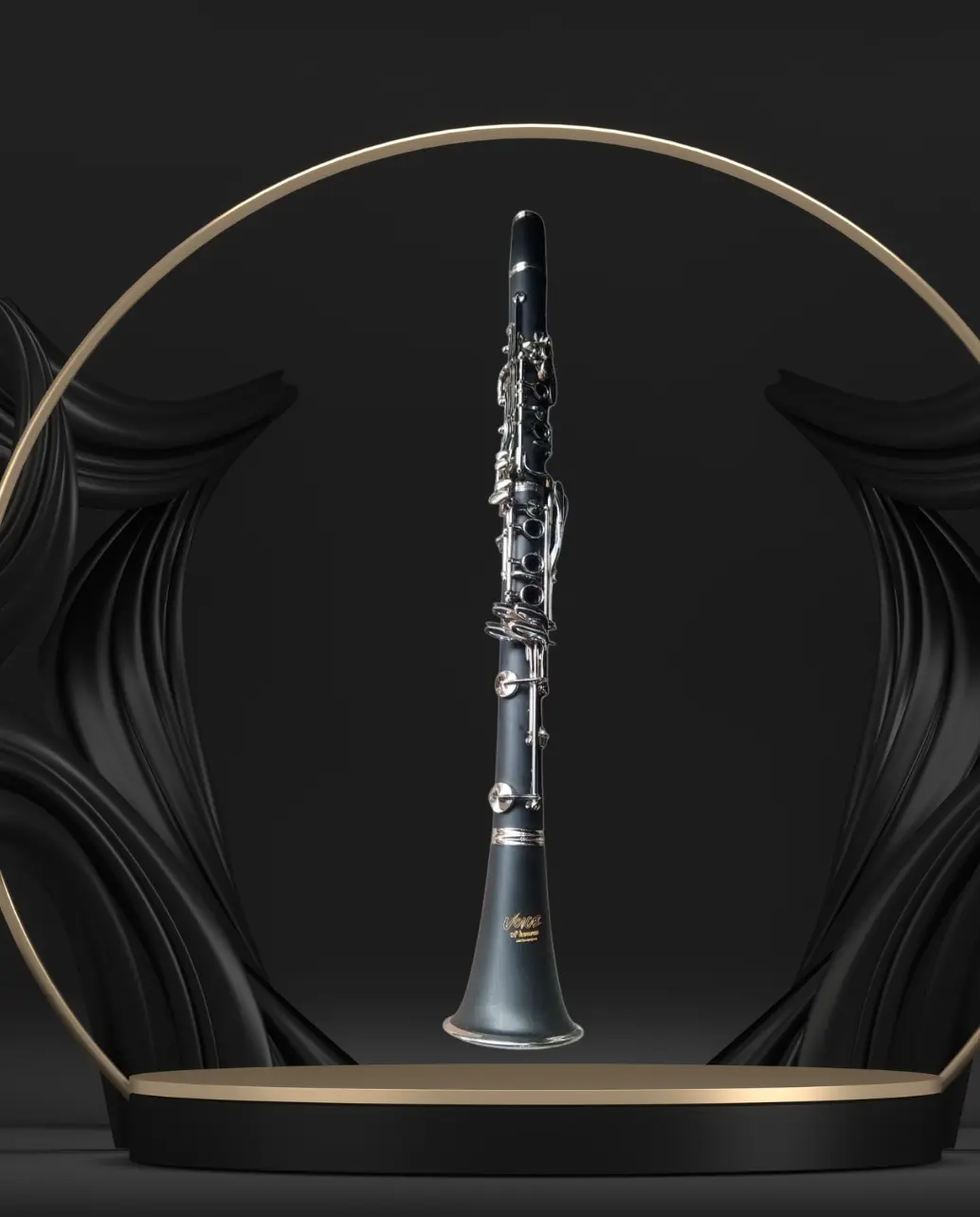
1. Acoustical Physics & Overblowing Behavior Unlike instruments with a conical bore (like the saxophone or oboe), the clarinet features a cylindrical bore that acts acoustically as a stopped cylindrical pipe. This configuration suppresses even-numbered harmonics, giving the instrument its characteristic hollow, woody timbre. Because of this geometry, the clarinet overblows at a twelfth (an octave plus a perfect fifth) rather than a standard octave. This requires a dedicated register key (instead of an octave key) to vent the tube and shift the instrument into its upper register.
2. Physical Construction & Modular Sections A standard clarinet is engineered as a modular system consisting of five distinct joints/sections, precisely fitted together using cork tenons: Mouthpiece: Holds the single reed (usually made of Arundo donax cane) via a metal or fabric ligature. Barrel: A short, tapered tube that connects the mouthpiece to the upper body. It is highly critical for fine-tuning; players often swap barrels of varying lengths (e.g., 65mm vs. 66mm) to adjust the overall pitch. Upper (Left-Hand) Joint: Houses the keys operated by the left hand, including the register key, thumb hole, and top trill keys. Lower (Right-Hand) Joint: Contains the keys for the right hand and handles the lower fundamental notes. Bell: The flared bottom section that assists in acoustic projection and improves the intonation of the lowest notes in the instrument's range.
3. Keywork Mechanism (The Boehm System) Modern standard clarinets utilize the Boehm key system, adapting principles created by Theobald Boehm for the flute. It features a complex network of 17 keys and 6 rings (often designated as a 17/6 configuration). The mechanism uses pivot screws, needle springs, and blue steel flat springs to operate padded cups that seal tone holes. The pads themselves are traditionally made of bladder skin or felt, though professional models frequently use synthetic material (like Gore-Tex